The Cosmic Alarm Clock: Why This 'Dead' Star Just Woke Up, and What It Signals About Reality

A dormant neutron star has erupted, shaking the foundations of astrophysics. Discover the hidden implications of this massive cosmic event.
Key Takeaways
- •A previously quiet neutron star, specifically a magnetar, has suddenly erupted with intense energy.
- •The event challenges current astrophysical models regarding the stability and predictability of extreme stellar objects.
- •The immediate consequence is a likely surge in funding for high-energy cosmic observation projects.
- •The author predicts this magnetar will enter a sustained hyperactive phase.
The Cosmic Alarm Clock: Why This 'Dead' Star Just Woke Up, and What It Signals About Reality
Forget the noise about Mars colonization. The real story shaking the foundations of **astrophysics** just happened billions of light-years away: a seemingly dead neutron star has violently roared back to life. This isn't just another astronomical flash; it’s a profound challenge to our understanding of stellar evolution and the very nature of cosmic energy. We are witnessing a **magnetar**—a type of neutron star with an impossibly strong magnetic field—reboot its system, spewing out energy that dwarfs anything we can conceive. Why now? And who benefits from this stellar tantrum?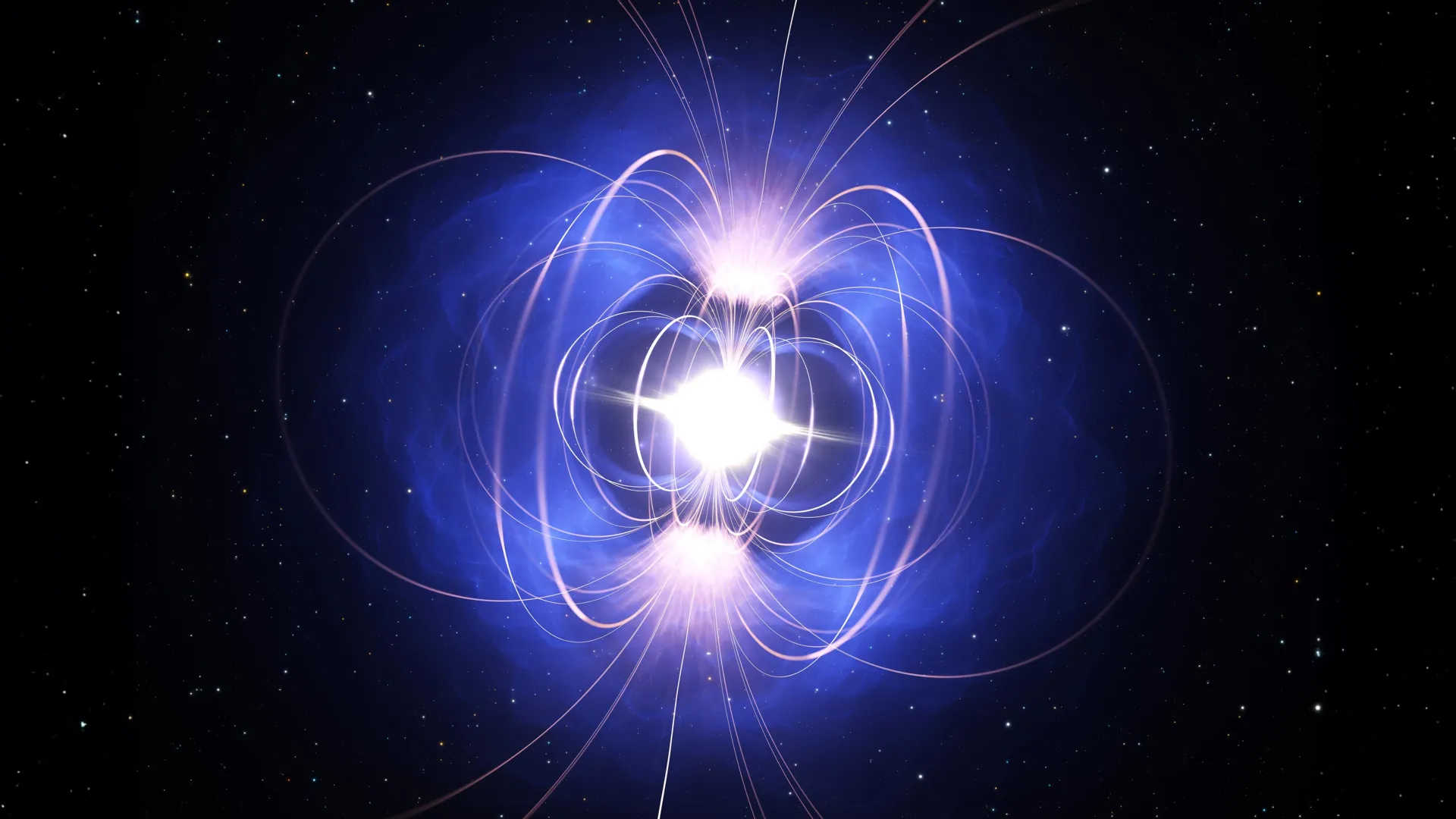 ### The 'Sleeping Giant' Wakes Up: The Unspoken Truth
The scientific community is calling this a 'transient event'—a burst of gamma rays or X-rays from a previously quiet source. But that minimizes the sheer violence. A neutron star is the ultra-dense corpse of a massive star, packing more mass than our Sun into a sphere the size of a city. A **magnetar** ups the ante with a magnetic field trillions of times stronger than Earth’s. When these things 'wake up,' it’s usually because the magnetic field lines, twisted beyond endurance, snap.
The unspoken truth is this: our current models struggle to predict these sudden energy releases. We treat these objects like predictable cosmic machinery, but they are proving to be wildly chaotic. Who wins? The institutions that fund the next generation of telescopes. This event guarantees massive budget increases for projects studying high-energy transients. Who loses? Anyone betting on a perfectly ordered, clockwork universe.
### Deep Analysis: Rewriting the Stellar Textbook
This sudden flare-up matters because it forces a confrontation with extreme physics. We are talking about forces that rip atoms apart and warp spacetime in ways general relativity can barely contain. The energy released in these brief moments can outshine entire galaxies. This isn't just about cataloging objects; it’s about testing the limits of physics under conditions impossible to replicate on Earth. We rely on these rare events—these cosmic stress tests—to validate or shatter our theoretical frameworks, especially regarding quantum gravity.
Consider the sheer scale. If you could somehow compress the Earth to the density of this object, it would collapse into a black hole. This celestial object is a natural laboratory for the absolute most powerful forces in the cosmos. The sustained observation of this event provides crucial data on how magnetic fields decay, how matter behaves under unimaginable pressure, and how these events contribute to the cosmic ray background. For more on the nature of these extreme objects, see the work done by NASA on **neutron star** physics [https://www.nasa.gov/]
### What Happens Next? The Prediction
**The bold prediction:** This isn't a one-off anomaly; it’s the start of a new observational era for this specific magnetar. Expect follow-up observations within the next 12 to 18 months to show this object entering a 'hyperactive state.' The magnetic field hasn't just momentarily stressed; it has been fundamentally reconfigured. This will lead to more frequent, albeit perhaps less energetic, bursts. Furthermore, the detection of gravitational waves coinciding with the next major flare will become the new holy grail for observatories like LIGO, finally linking electromagnetic radiation directly to spacetime distortions from these compact objects [https://www.ligo.caltech.edu/].
We are entering an age where the universe actively challenges our best equations. This waking star is not just a spectacle; it’s a cosmic dare to the scientific establishment.
### The Takeaway
* A dormant **magnetar** has experienced a massive energy release, defying simple predictive models.
* This event guarantees increased funding for high-energy **astrophysics** research.
* It serves as a crucial, real-world test for theories concerning extreme gravity and magnetic fields.
* Expect this specific object to become significantly more active in the near future.
### The 'Sleeping Giant' Wakes Up: The Unspoken Truth
The scientific community is calling this a 'transient event'—a burst of gamma rays or X-rays from a previously quiet source. But that minimizes the sheer violence. A neutron star is the ultra-dense corpse of a massive star, packing more mass than our Sun into a sphere the size of a city. A **magnetar** ups the ante with a magnetic field trillions of times stronger than Earth’s. When these things 'wake up,' it’s usually because the magnetic field lines, twisted beyond endurance, snap.
The unspoken truth is this: our current models struggle to predict these sudden energy releases. We treat these objects like predictable cosmic machinery, but they are proving to be wildly chaotic. Who wins? The institutions that fund the next generation of telescopes. This event guarantees massive budget increases for projects studying high-energy transients. Who loses? Anyone betting on a perfectly ordered, clockwork universe.
### Deep Analysis: Rewriting the Stellar Textbook
This sudden flare-up matters because it forces a confrontation with extreme physics. We are talking about forces that rip atoms apart and warp spacetime in ways general relativity can barely contain. The energy released in these brief moments can outshine entire galaxies. This isn't just about cataloging objects; it’s about testing the limits of physics under conditions impossible to replicate on Earth. We rely on these rare events—these cosmic stress tests—to validate or shatter our theoretical frameworks, especially regarding quantum gravity.
Consider the sheer scale. If you could somehow compress the Earth to the density of this object, it would collapse into a black hole. This celestial object is a natural laboratory for the absolute most powerful forces in the cosmos. The sustained observation of this event provides crucial data on how magnetic fields decay, how matter behaves under unimaginable pressure, and how these events contribute to the cosmic ray background. For more on the nature of these extreme objects, see the work done by NASA on **neutron star** physics [https://www.nasa.gov/]
### What Happens Next? The Prediction
**The bold prediction:** This isn't a one-off anomaly; it’s the start of a new observational era for this specific magnetar. Expect follow-up observations within the next 12 to 18 months to show this object entering a 'hyperactive state.' The magnetic field hasn't just momentarily stressed; it has been fundamentally reconfigured. This will lead to more frequent, albeit perhaps less energetic, bursts. Furthermore, the detection of gravitational waves coinciding with the next major flare will become the new holy grail for observatories like LIGO, finally linking electromagnetic radiation directly to spacetime distortions from these compact objects [https://www.ligo.caltech.edu/].
We are entering an age where the universe actively challenges our best equations. This waking star is not just a spectacle; it’s a cosmic dare to the scientific establishment.
### The Takeaway
* A dormant **magnetar** has experienced a massive energy release, defying simple predictive models.
* This event guarantees increased funding for high-energy **astrophysics** research.
* It serves as a crucial, real-world test for theories concerning extreme gravity and magnetic fields.
* Expect this specific object to become significantly more active in the near future.Frequently Asked Questions
What is the difference between a neutron star and a magnetar?
A neutron star is the collapsed core of a massive star. A magnetar is a specific, rarer type of neutron star possessing an extraordinarily powerful magnetic field, often trillions of times stronger than the Sun's.
Why is a 'sleeping' neutron star suddenly 'roaring back to life' significant?
It signifies that the magnetic field structure has dramatically changed or snapped, releasing immense stored energy. It challenges our ability to model the long-term stability of these compact objects.
How much energy does a magnetar flare release?
The energy released in a major magnetar flare can briefly outshine the entire Milky Way galaxy combined, though the event lasts only milliseconds to seconds.
What authority backs the study of these cosmic events?
Major space agencies like NASA and ESA, along with ground-based observatories and gravitational wave detectors like LIGO, are central to studying these high-energy transients [https://www.universe-today.com/].